DETROIT ~ Amid growing backlash against automated license plate readers (ALPRs), the CEO of one of the key makers of these camera systems wants to reassure the public that its systems are about public safety and not violating privacy.
Flock Safety is the leading producer of ALPRs, which capture photos of license plates and vehicle details of cars on roadways, parking lots, and shared access points. Simultaneously, the cameras also record data about the location, date, and time a vehicle’s image was captured, according to Flock’s website. These cameras are used primarily by local governments and police departments in criminal investigations to flag vehicles of interest, though reassurances from the company on data collection have not cooled concerns from privacy activists over the proliferation of these cameras.
VIDEO:
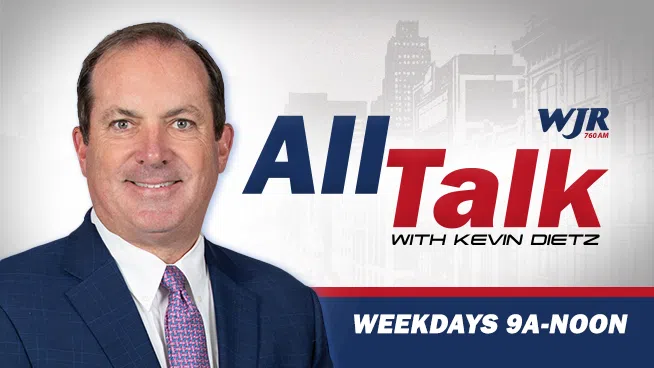
Aug. 12, 2026 ~ Garrett Langley, CEO of Flock Safety, joins Kevin Dietz in studio to discuss the technology helping law enforcement agencies solve crimes, improve public safety, and address privacy concerns surrounding surveillance systems.
“I started this company nine years ago, (and I) just wanted to live in a safer neighborhood,” Flock CEO Garrett Langley told WJR. “I live in Atlanta, and I didn’t understand why this would be so valuable. I didn’t realize that 70% of crime starts with a car, ends with a car.“
While he said that facial recognition is not part of Flock’s uses and only records vehicle information, organizations like the American Civil Liberties Union (ACLU) have raised concerns about mass surveillance, arguing that ALPRs can be used to invade people’s private lives by tracking them from houses of worship, protests, medical centers, and more. The organization has been pushing back against ALPRs at the local and state levels across the country by engaging with local activists, pushing to retract existing Flock contracts, and potentially banning the use of ALPRs altogether or getting governments to adopt guardrails on ALPR data sharing and retention.
“It is hard to roll out 120,000 ALPR cameras and counting and not have the public notice,” Chad A. Marlow, senior policy counsel at the ACLU, told WJR. “Once the public noticed, their objections were loud, relentless, and effective – not to mention entirely non-partisan. In truth, we’d have the same pushback against all other government mass surveillance techs if they were as easy to notice as Flock ALPRs.“
The backlash against Flock over the past year has manifested into acts of vandalism and destruction, including a recent incident from Winona, MN, where someone cut down and stole all eight of the Flock cameras in the town. City council meetings across the country have been swarmed with residents pushing back against contracts for ALPRs in their communities, including in Michigan. So far, the cities of Ferndale, Bay City, and Westland have either failed to pass contracts with Flock or cancelled them.
While there are no official counts of ALPRs installed in the U.S., the volunteer-based activist group DeFlock gathers user-submitted information on where they have been installed and maps them out for people to see where they have been put up in their communities. According to their database, over 100,000 have been put up nationwide and over 3,000 in Michigan. Langley estimates that a third of the state’s communities use Flock cameras.
Langley said that concerns over privacy are “real” and has worked to address these concerns with local communities. He said he had a conversation with a mayor in Michigan about using Flock systems in their town, and reminded them that the city can set how long the pictures can be stored. He added that pictures are typically stored for 7 to 30 days and are permanently deleted if they are not used in investigations.
“Read our contracts. We got 7,000 cities under contract, and they all say the same thing: our customers own the data. Our customers can control it,” Langley said. “But we got to do a better job explaining how this system works.“
Another point of concern surrounding Flock surveillance systems has been the abuse of the system by some police officers across the country. A Washington Post report found at least 50 known cases of police officers who have used Flock cameras to track and stalk exes, romantic partners, or other women, including a case from Georgia where a deputy was fired and arrested for using Flock cameras to track someone he was in a “personal relationship” with.
Langley said that other government systems have been misused in the past by police, while claiming that Flock has accountability checks built into their systems to detect these abuses. However, Marlow said that when “privacy is traded for profits,” abuses of this type of system are inevitable.
“While police officer abuse of the Flock system was inevitable and is deeply regrettable, the bad acts of a couple dozen or even hundreds of irresponsible cops are not nearly on the same level of eviscerating the privacy of 350 million Americans,” he said. “The police cases do further demonstrate that Flock’s mass data collection and sharing business model creates unacceptable risks and that Flock is incapable of controlling.“
Langley, though, maintains that ALPR technology is an effective tool for law enforcement, claiming that Flock helped find 10,000 missing people. He added that the system can ping vehicles associated with a felony warrant, a missing child, or an Amber alert.
“It’s a balance,” Langley said. “If we stored this data forever, we’d solve more crimes, but I think we all feel that feels wrong. We probably shouldn’t store where people go, where they drive by, forever. So we said 30 days is a pretty good thing. Now, what we believe is I shouldn’t make that decision. State regulators should, and so in nine states this year, they’ve made decisions that roughly 21 days is a better balance of both efficacy and privacy.“
However, Marlow said that opposition to Flock and mass surveillance is not about hiding bad conduct; it is to do with maintaining privacy and avoiding a chilling effect on the exercise of any person’s freedoms. For instance, he argued that someone struggling with alcoholism may skip Alcoholics Anonymous meetings if they don’t want to be tracked to these meetings and reveal private information about themselves.
“When people are being tracked all the time, it impacts their sense of privacy, freedom and chills the exercise of their rights,” he said. “Worse still, if we don’t draw the line here, mass government surveillance and privacy intrusions will only continue to get worse.“