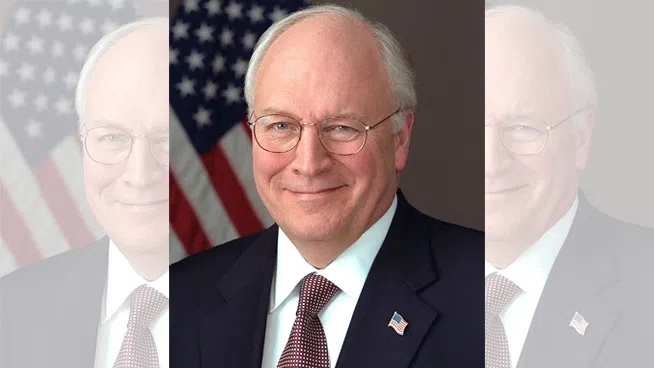
Former Vice President Dick Cheney, who pushed the lines of power of the seat, died Monday at the age of 84, leaving behind a polarizing legacy.
Cheney, who had a long history of heart issues, died due to complications of pneumonia, cardiac and vascular disease, according to a statement from his family. George W. Bush, the former president whom he led the nation with during the turbulent 2000s, said Cheney’s death “is a loss to the nation and a sorrow to his friends.”
Cheney was a former Wyoming congressman, U.S. secretary of defense, and CEO of oil service company Halliburton. His time in leadership is most defined, though, by the work the Bush administration did following the attacks on the World Trade Center on Sept. 11, 2001.
PODCAST:
Nov. 4, 2025 ~ Former Congressman Dave Trott joins Chris Renwick and Jamie Edmonds to remember former Vice President Dick Cheney after he died Monday night at the age of 84. Photo: Tim Dillon ~ USA TODAY NETWORK
(CONTINUED) Cheney was a strong proponent of the invasion of Iraq in 2003, justified by claims that then Iraqi President Saddam Hussein harbored weapons of mass destruction, which were never found. He also tried to link the Iraqi government with al-Qaeda and 9/11, statements that were later disproven.
Even though no WMDs were found, Cheney would defend the invasion, saying that Hussein needed to be removed from power. The war, though, grew to be very unpopular with the U.S. public, with polling from Pew Research showing that public opinion of the war fell from 74% supporting it shortly after it began, to 75% of the public wanting to withdraw all troops from Iraq by 2008.
The larger war on terror, which was supported by Cheney, also drew more scrutiny over its mounting civilian death toll in the Middle East, with an estimate from Brown University putting the death toll at around 432,000. Cheney’s authorization for the use of “enhanced interrogation,” or torture, in places like Guantanamo Bay also drew controversy. His connections to Halliburton also drew scrutiny after the oil company’s subsidiary KBR was rewarded with large federal contracts connected to the Iraq War.
These issues saw Cheney’s public approval rating fluctuate over time. Shortly after 9/11, Cheney saw a positive approval rating of 68%, according to Gallup. However, his approval rating fell to just 13% when he left office, according to CBS News/New York Times polling.
He found new admiration amongst liberals, though in the lead-up to the 2024 presidential election, when it was announced that he and his daughter, Liz Cheney, would be voting for Democratic nominee Kamala Harris, despite being Republicans. They were vocal critics of now-President Donald Trump, who has yet to give a statement on Cheney’s death.